Instructional Leadership: The Heartbeat of School Administration

Being a school administrator is an enormous responsibility. There are a variety of roles school administrators must fill. They must be excellent communicators, great relationship builders, and good managers of people, resources, and processes. School administrators have the audacious task of serving students, parents, teachers, and staff. This is not an easy task. It is complex and difficult. The days are long, the rewards great, and the pressure to do it all and do it well is present. At the heartbeat of school administration however, is instructional leadership. Too often, folks pursue the leadership role for its surface structure. They think it might be fun to be the face of the school or perhaps they are attracted to the idea of being in charge…whatever that means. What happens often in school administration is that those with a love of instruction and curriculum, with teaching and pedagogy see the administrative route as a mismatch for their skill set and passion. I contend that those people are exactly who we need as instructional leaders and school administrators.

High-Expectations are not enough.

So many school leaders believe they are charged with setting high expectations for staff and students, and while that may be true, high expectations alone aren’t enough. A leader who compells his her staff to change and provides an explanation of why change is neccessary isn’t the same as one who also shows staff how to change. Of all the time school adminstrators spend in school buildings, providing valuable feedback to teachers around the how of change is most critical. Too often the focus is centered on what and on why, with little attention given to the how, and teachers find themselves searching and trying to figure out exactly what the principal wants to see in their classroom. Instructional leaders must move beyond a compelling why and a clearly defined what. They must give teachers a clear articulation of how their teaching and/or pedagaogy should change to improve student outcomes. An instructional leader sees this as the most important mechanisim by which her or she can effectuate change in instructional practices and thereby advance student learning. A simple demand for teachers to perform better, be more effective, and the like just isn’t enough.

Coach the behavior to coach the data.

My sister, who has a career in business, said to me in one of our many conversations, “You can’t coach data. You coach behaviors.” I was awestruck by her idea. In a field like public education where we use the term data-driven as often as an article in the English language, I took a few minutes to process what she was saying. She went on to explain that in order to help people produce better results, you have to focus on the behaviors that are neccessary for such improvement. A simple conversation around data, around a percentage of students who have not met standards, around the number of students who didn’t fare well on the assessment, won’t produce a change in practice. To change practice, we must coach behavior. That is, we must coach teachers around the instructional practices that impact student learning. Data in and of itself tells us what’s wrong and where to look, but it does not tell us how to fix it and that is precisely what people need to know: how to fix it. Instructional leaders don’t just point out what is wrong. They are precise in guiding and coaching teachers on how to fix those areas of ineffectiveness.

Start with your learning.

I want to know what makes effective teachers effective. I want to be certain about what practices are those that make learning most possible for students. To learn that, I read a great deal. I study. Recently, I’ve been digging deep into Cognitive Science. This has been a very interesting personal research study because it makes clear what many scholars have written about in terms of high-yield learning strategies. Our brains are in best shape to learn when we account for cognitive overload, analogical transfer, and constructivisim. If we know this, our duty as professionals is to dig deep into the pedagogical structures and strategies that best account for these. Instructional leaders don’t guess about how to make academic learning and effective teaching happen. They study it. They read. They research. Instructional leaders are learners first and foremost.

At the core of being a school administrator, is the responsibility for teaching and learning. Instructional leaders see their purpose as two fold: to improve teacher practice and to advance student learning. Everything else is icing on the cake.

Until next time, Be you. Be true. Be a hope builder.
@latoyadixon5

Reflections on 2018 #OneWord: FORWARD

My #oneword for 2018 was FORWARD. I wanted to concentrate on moving forward in every aspect of my life and work diligently to improve my resilience. In 2017, I had a breakthrough moment in my personal life. I realized that I had likely spent half of my life (if I am blessed to live an equal amount beyond the present) worrying. I worried about everything, no matter how big or how small. I took myself too seriously. I spent a great deal of time trying not to make any mistakes and then digging myself out from beating myself up for having made an error of some kind. It dawned on me that for all the worrying I had done, none of the things I often feared as my mind went to worst case scenario had actually come to fruition. I resented all the nights I could not sleep, all the time I spent worrying instead of having fun, and I promised myself in 2018 that I was done worrying. No more sleepless nights, no more stressing out over things I could not control, and no more trying not to make any mistakes…a nice way of saying I was releasing myself from my perfectionistic tendencies.

Some people who know me are likely to say they don’t see this or didn’t know this, but ask any of my closest friends, any of my former supervisors, or my family and they will tell you it is true. I need no external pressure to do a good job. I do an outstanding inside job of that on my own. I have always struggled with anxiety. From the time I was a small child, I was described as conscientious. At school I was usually able to hold it together, but at home I battled with worry and anxiety often. Whether it was math homework frustration or worrying because my mom was later than usual getting home, my worry wire was active at an early age. Being conscientious is a part of who I am, but it no longer holds me hostage or sends me into a spiraling series of self-doubt. After nearly 20 years as an educator and a work record that I am proud of, I recognize that this life is short and I’ve given it my best and plan to continue doing so. That is enough and it always will be.

I chose the word FORWARD for 2018 because I wanted to focus on moving on, not getting bogged down in what went wrong or what might go wrong, but having a really balanced perspective that didn’t require an unrealistic pressure to get everything right the first time. I still focused on doing my best but I accepted that mistakes would be inevitable. I would make them, but the important thing was to focus on how to move forward, on my ability to bounce back and move on, on my resilience. I am so glad I did because 2018 was a great year.

In 2018 I found myself focused on being happy, having fun, and working hard. For me, the word FORWARD, didn’t mean to keep going in a careless manner. Instead it meant to move forward with courage, and to not allow fear to hold me hostage. This prevailing thought gave me freedom in ways I never imagined. I didn’t overthink wearing my favorite sneakers, Air Jordan’s, on the weekend, releasing my self published book, making rap music for fun, or writing more scholarly articles and submitting them for publication even if rejection would be the result. I trusted myself and my abilities. I finally realized that no matter what happens I would be alright and it, whatever it was, would also be alright. Experience said so. In 2018, I gave myself the freedom to be me and I have never felt more free and happy. There’s still room for growth, but I am off to a good start and I feel amazing. I hope this continues in 2019 because it’s amazing what the word FORWARD did for me in one year and I can only imagine what might be if I can keep this trend going for years to come. That’s why my #oneword for 2019 is FORWARD. It’s my eternal resolution.

Until next t time-Be you! Be true! Be a hope builder!

Latoya

@latoyadixon5

The Competition Myth: Confronting the Consequences​ of Making Public School a Competitive Experience

Many economists assert that competition is a driving force that catalyzes improvement in businesses. BusinessDictonary.com defines it this way:

Competition:
Rivalry in which every seller tries to get what other sellers are seeking at the same time: sales, profit, and market share by offering the best practicable combination of price, quality, and service. Where the market information flows freely, competition plays a regulatory function in balancing demand and supply.

I am no business expert, but I think I have a basic understanding of this concept. Let’s use an analogy to help make this clear. Apple’s iPhone has driven the market in cellular phones. Samsung, LG, Tracfone, and others have had to improve their combination of price, quality, and service when it comes to the smartphone movement. As Apple has linked several of its’ other devices to the smart phone-think Apple Watch, Ipad/Ipad Pro, MacBook, it has created a community of consumers who more often than not own multiple products. By making sure the smartphone they design changes the way we work, live, socialize, and entertain ourselves, they force companies like Samsung and LG to create products like the Galaxy that can perform similar functions for a more reasonable price. This theory works well for products, for actual things because it diversifies the market, ensures that company innovations match consumer needs, and creates an opportunity for everyone to have a smartphone, even if they can’t afford iPhone X.

Some believe this same concept can help create better schools, and force educators to improve their practices to remain relevant in the market. They argue that adopting this philosophy to teaching and learning can help create better-prepared teachers, more motivated students, and force school districts to improve the quality of learning they offer when parents have other choices for their child’s educational experiences. A fundamental reason for competition is its effects in creating a diversified marketplace for better schools. After many years of a great deal of advocacy for a competitive mindset to be applied to American schooling, one has to ask, have all of our schools improved and gotten better as a result of this competition mindset we’ve adopted?

Hart and Figlo answered that question this way in their 2011 Education Next article, Does Competition Improve Public Schools

It is notoriously difficult to gauge the competitive effects of private schools on public school performance. Private schools may be disproportionately located in communities with low-quality public schools, causing the relationship between private school competition and public school performance to appear weaker than it actually is. If, however, private schools are located in areas where citizens care a lot about educational quality, the relationship will appear stronger than it truly is.

Other scholars now say that competition improves not only the quality of public schools but can also improve outcomes for students. In Bozzo’s 2016 article, School Vouchers: A Vehicle to Induce Greater Competition In Public Schools, she concludes:

“Many previous voucher studies have found that programs are successful at increasing competition and student academic outcomes but only on the lowest and highest performing public school students and in the most competitive school districts. Therefore, voucher programs are not an education reform that will work for all student groups and for all states, and vouchers will not be the panacea that will help all low-performing students to catch up. Moreover, precautions must be taken to ensure that heightened scrutiny and competition do not lead to negative unintended consequences, such as cheating and increased stress for students. Despite these limitations, greater competition has led to increases in student achievement in public schools in Ohio and Florida, particularly among the lowest performing students. Future studies and efforts should continue to identify the distinctive populations and contexts that can successfully use vouchers to foster greater competition and promote improvements in educational performance, particularly for vulnerable populations.”

The question I am left with is who are the children that end up on the downside of this competition? Unlike second place smartphones like the Galaxy when compared to the Iphone X, I believe none of our children deserve a second place education. When competition comes into play, it means there are winners and losers. It means someone has to be the best and someone has to be the worst. It means some schools have to be exceptionally better than others and some have to be exceptionally worse. That troubles me greatly because I believe all children deserve a high-quality education and none deserve to be on the lower end of the competition chain in their educational experience. What happens to those children whose parents don’t have the means or capacity to choose? What happens to the children whose mothers and fathers happen to not be engaged at all in their education? Who deserves the Iphone X education versus the Tracfone education?

The competition concept is a myth because I am uncertain as to whether it makes us ALL better. Instead, I believe it creates exceptionally great access and educational opportunity for some while others are left behind. I worry often that choice, which sounds good in theory, leaves some students with no choice at all. I think the education of students is far too complex to apply a broadly based business theory to an exercise in human interaction. I may be too utopian and idealistic in my beliefs, but I can’t help but think about the children on the bottom of the competition and what it means for them.

I think we’d be wise to look at this concept as something to be applied based on context, if and when it can be helpful, instead of broadly across public education. I remain uncertain as to how this impacts teacher and leadership retention, and how it impacts the rhetoric that some public schools are failures when in reality the idea of competition means someone has to fail in order for someone else to succeed. I have no answers for this myth, except to say it is something that stays heavily on my mind. What I know for sure, is that I believe all means all and that all students deserve the absolute best education we can offer them and I am not sure that is something we should make competitive.

Until next time- Be you! Be true! Be a hope builder!

Latoya

@latoyadixon5

The Zip Code Myth: Dismantling Predictive Geography

We’ve all heard it before. A child’s zip code should not determine the quality of education they receive. We’ve sat through or read numerous pieces on why we cannot continue to allow zip codes to determine the success of our children. I agree. I believe with my whole heart that every child deserves a quality educational experience that allows him or her to reach their highest potential. However, it almost seems silly for us to reduce the well known inequity students experience to geography and zip codes. We need to go beyond the idea that location of where you receive your education matters and dig deep into the mindsets that hold some communities hostage in the fight for equity.

I guess my frustration with the zip code argument is that there is nothing one can do, no action a student can take, to change where he or she lives. Additionally, seeking teachers or educational leaders who are “beating the odds” signifies that we’ve given up on changing mindsets, on creating more equitable communities, on calling out White flight and segregation academies meant to keep children separated during the time they spend in school. All the zip code rhetoric in the world doesn’t answer these questions:

1. Why can’t all of our students attend a quality school together?

2. Why can’t we pool our resources and provide a great education for every child instead of spreading resources and opportunities thin because there are separate systems of schooling (both formally and informally)?

In Mark Elgart’s 2016 Huffington Post article, Student Success Comes Down To Zip Code, he shares:

A study recently released by sociologist Ann Owens of the University of Southern California showed that access to good schools in the nation’s 100 largest cities continues to exacerbate income inequality between neighborhoods. Income disparities in communities increased by 20 percent from 1990 to 2010, largely because of the desire people have to live within the boundaries of top-performing schools. The study also indicates that income segregation between neighborhoods was nearly twice as high among households that have children compared to those without.

Instead of talking about the impact of zip codes and residential location on school quality, why isn’t there more conversation around who is drawing attendance lines that exacerbate inequity? Why aren’t we discussing how we can create more mixed income neighborhoods? What’s keeping us from talking about the root causes of the income disparities this researcher speaks of and how we begin changing that?

Zip codes aren’t the problem. It’s the mindsets of those who have forgotten or either don’t believe that the public education of all children is for the public good of all of us. As long as we champion a “beat the odds” mentality instead of a “level the playing field one” the zip code narrative will hold true. While I applaud every student who overcomes the obstacles of poverty and trauma, and every educator who is able to help students be successful in spite of the obstacles they face, wouldn’t it prove helpful to work on reducing the disparities and obstacles instead of giving all of our energy and attention to how we overcome them? If we were to spend more time addressing the causes instead of the effects, perhaps we might be able to shift this conversation to one that boldly and courageously addresses what we’ve known to be a key issue in our work since James Coleman’s 1966 report: We are better together. Coleman notes,

The research results indicate that a child’s performance, especially a working-class child’s performance, is greatly benefited by his going to school with children who come from different backgrounds,” Coleman said. “If you integrate children of different backgrounds and socioeconomics, kids perform better.”

We have an opportunity before us as educators to call on policy makers and others who make decisions about economic development, jobs, quality housing, and more to help reduce the inequities that plague these areas where zip codes are credited for the lack of success children experience. If we know we are better together, that all of our children are better when we educate them together, let’s stop talking about zip codes and start talking about how we can live, work, and learn together for the benefit of all involved.

Until next time- Be you. Be true. Be a hope builder!

Latoya

@latoyadixon5

The Expectations Myth: A Stubborn Refusal to Address Bigotry and Bias In The Classroom

High expectations matter. There’s no doubt about that. There’s plenty of research to support the claim that teacher expectation matters a great deal when it comes to student outcomes. In 1968, Rosenthal and Jacobson published Pygmalion in the Classroom. This study provided evidence that teacher expectations can significantly impact student achievement. You can read more about the historical overview of scholarly research on the impact of teacher expectation here. Today, as I read multiple perspectives on the achievement gap and listen to practitioners it seems the solution is often boiled down to this: “The soft bigotry of low expectations.” These words came from then Gov. George W. Bush of Texas in 1999 in a speech he gave on how he planned to improve education. It’s not that I disagree with the significant impact expectations has on our students, but here’s the myth: Expectations alone won’t fix the achievement gap because these low expectations are rooted in something far more detrimental: bigotry.

For years I’ve listened to speaker after speaker share insight on how low expectations are the cause of the gap in performance between minority children and their White counterparts. While that may be partly true, the root cause of this is due to bigotry, prejudice, and systemic oppression sometimes inherent in our policies and practices in public education. Let’s get real honest here. Giving high expectations lip service doesn’t mean one truly believes that all students deserve a high quality education.

It is important and essential for us to acknowledge that being educators doesn’t mean we are universally agnostic to bias or prejudice of any kind. It means recognizing we all bring our biases to the table and it is our professional and moral responsibility to check ourselves and others when we see these skewed perceptions or biased beliefs and attitudes manifesting themselves in our classrooms and our school buildings.

If we were to really tackle the achievement gap, there are lots of things we would do, but one of them is that we would move the conversation beyond low expectations and really get at the heart of bias and bigotry. We’d talk through how we end up with skewed perspectives when we limit our personal experiences to being around other humans who live, work, worship, love, and believe like us. We’d end up digging deep into people’s hearts before we tried changing their minds. Even then it may not change anything, but the perpetual conversation around low expectations for Black and Brown children hasn’t either. I’m convinced it is because most are afraid to call it what it is: bigotry and bias. I don’t see it as soft either, but that’s a post for another day.

Those individuals who desire to lead with equity at the center must understand that this work goes far beyond having high expectations for all. It means recognizing when there are policies or practices that create inequity (intentionally or not) and making changes to those to create a more equitable experience for all students. Every educator has a set of core values that impacts their perspective and behavior. It can be difficult to see the inequity in practices and policies depending on your experiences, and especially if you’ve not been on the end of a practice or policy negatively impacting your access and opportunity. If leaders are interested in leading with equity in mind,they evaluate every decision with reflection questions like these:

1. Who are we leaving out?

2. Who is being excluded?

3. What barriers are impeding their access and/or opportunity?

Then, they work tirelessly to remove the barriers so that when they use the phrase “all students” it truly means all students. They call out practices that exclude and offer solutions to make them more inclusive and equitable. They build in deliberate ways to ensure that low expectations are checked along with bias. They create policies and practices that create a more equitable experience, equitable access, and equitable opportunities for all students. They are courageous enough to do this even when they are alone in their advocacy.

If we truly are interested in closing the achievement gap, we’re going to have to talk about the root causes: hearts and minds that believe some students are less capable and deserve different opportunities than others. The conversation will be difficult, but it has the potential to lead us to a place we’ve needed to address from the very beginning: the hearts of those who serve.

Until next time! Be you! Be true! Be a hope builder!

Latoya

@latoyadixon5

The Turn Around Myth

In the Spring of 2014, I graduated with my Doctorate of Philosophy from the University of South Carolina. After five long years of a rigorous and intense dual Education Specialist and Doctorate of Philosophy program, I was looking forward to nights and weekends again. Additionally, I was seeking a new professional challenge. I had served as principal in the same school for 6 and a half years and our school was able to make dramatic improvements in student achievement. For five consecutive years, our standardized test scores improved. We were proud of our hard work and the success of our students, yet I knew it was time for a new professional challenge. In a discussion with a colleague and fellow administrator, I expressed my desire to embark on a new journey. My colleague agreed that it was indeed an appropriate professional next step for me. She said, “Latoya, face it. You are a turnaround principal.” I accepted what she said at that moment. I had heard the term before. It was a term for principals who had gone into underperforming schools and helped improve their test scores or who were leaders who were able to help their school be removed from the state’s low performing list and those people were considered a rarity in the profession. My next professional move had to be just that if I was going to be able to be seen as a turnaround leader.

I spent the next few years at a low-performing middle school in North Carolina. Using a co-principal model and with the opportunity to work daily with my dearest friend and colleague, Michael Waiksnis. We wanted to improve our school. We implemented professional learning communities, improved the climate and culture as evidenced by the teacher working conditions survey, and after two years of diligence, hard work, sweat, and many tears and frustrations, the school was no longer on North Carolina’s low performing list. We celebrated. We were thrilled that our efforts had manifested in the way in which we needed them to in order to be removed from the low performing list. I went on to undertake a new professional challenge, working with low performing schools at the state level just across the border in my home state, South Carolina.

After nearly 20 years in public education, I must confess something here in this blog: I am not a turnaround leader because turnaround leadership is a myth. That’s right. I said it. I see myself as a transformational leader now, and it’s far more accurate than the trendy word, turnaround, that is used in education far too often. I am sure some are wondering where my ultimate aim might land with this post. If you’re brave enough to consider something different than what others generally believe, keep reading.

When public educators and others use the word turnaround leader or school turn around, what exactly are they referencing? What has to change for a school leader to be considered or categorized as a turnaround leader?  In my experience, it seems that the turnaround is only about raising student achievement on a standardized test. What’s often left out of the concept of turnaround are all the other things that also need to be turned around: inequity, teacher and principal retention and recruitment, community and/or district mindset, culture, climate, equitable access and opportunity for students, and more. While we may, in fact, be able to improve test scores in spite of serving high concentrations of low-income students, our ability to raise the test scores of students doesn’t turnaround the other equally and sometimes significantly more important elements that impact students in ways far beyond their K-12 experience.

We have yet to implement a solution or deliberate strategy to close the achievement gap. Instead, we seek leaders who can help students improve their performance on standardized tests in spite of all the barriers and obstacles they face. We accept the barriers and laud those who can improve test scores in spite of at all as turnaround leaders. I find this extremely problematic because this is, in essence, an acceptance of the inequity our students of poverty and often, of color face. Our youngsters in high poverty schools across our country are often taught in educational settings that are highly segregated by socioeconomics and sometimes race. They are often also subjected to less experienced and effective teachers, to a constant turn over of school and district leaders, and to fewer opportunities and access to more rigorous and advanced coursework, extracurricular activities, and the like. While test scores may take a different direction, these things that also gravely impact the success of students well beyond their K-12 years, don’t turn around at all.

When we subscribe to language and usage of terms like school turn around, we inadvertently agree that subjecting students to a less equitable learning environment and still being able to educate them enough to pass the standardized test as acceptable. While I am very proud of the work we did in both schools where I served as a principal, I remain concerned about the struggle to find and retain effective teachers and school leaders, the lack of access and opportunities for students of poverty, the impact of schooling in environments where there is a lack of resources and a high concentration and homogeneous grouping of students from disadvantaged backgrounds, and the turnover in teacher and school leaders for these students, which I too, contributed to as a leader who left after just a few years.

Screen Shot 2018-09-15 at 4.11.31 PM

Read my book Burned Out, Beaten Up, Fighting Back: A Call To Action For America’s Public Educators to learn more about that.

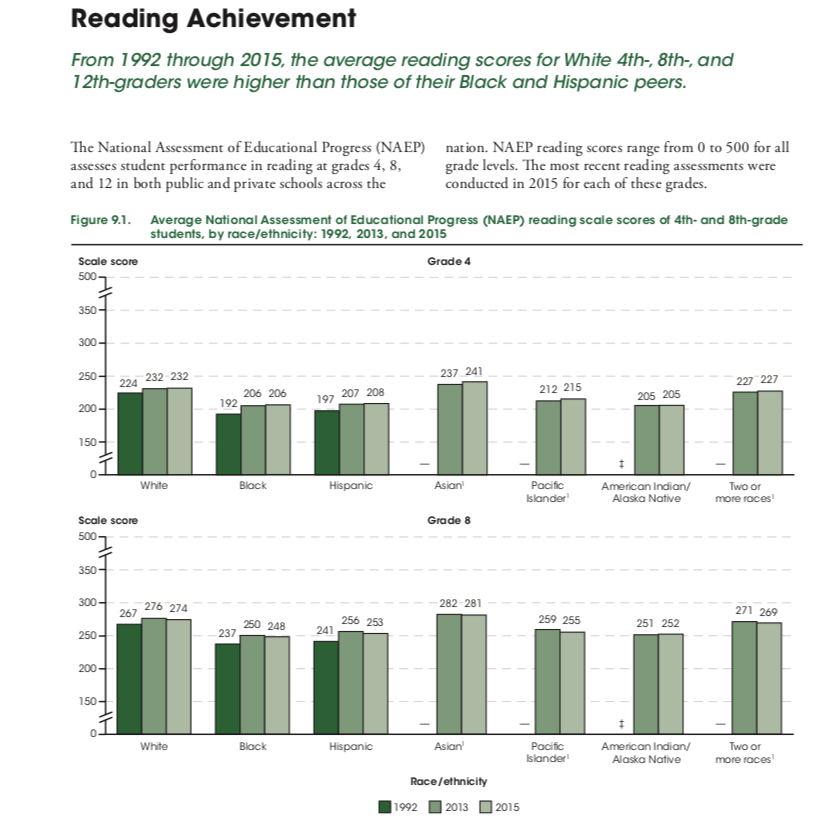
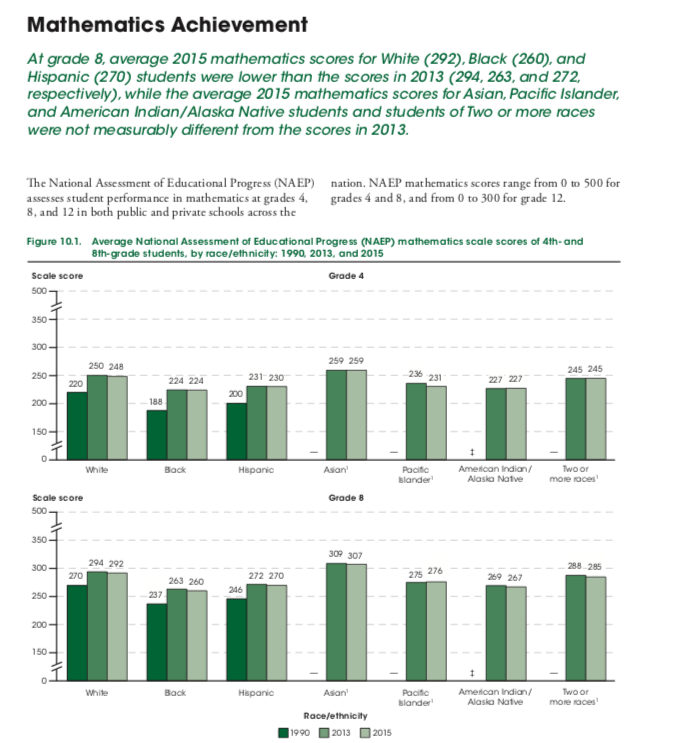
If turn around leadership were a real concept, our country would not have an achievement gap among students of various backgrounds and races in reading and math that persists across the country,  in spite of all the turn around leaders. You can read more about the persisting gap here.

screen-shot-2018-11-09-at-1-14-29-pm.png
From: https://nces.ed.gov/pubs2017/2017051.pdf

Screen Shot 2018-11-09 at 1.17.30 PM.png
From: https://nces.ed.gov/pubs2017/2017051.pdf caption

Perhaps what we need  are not turn around leaders, but courageous and brave leaders who are willing to work to turn around the mindsets about the impact of creating schools of high concentrations of poverty, the idea that excelling in spite of having less access and opportunity to rigorous courses is something to applaud but also something to change, who are willing to admit that our issues of inequity and the achievement gap will not be solved and cannot be changed by simply hiring strong instructional leaders who can move test scores in a positive direction. While test scores may turn around, to improve the quality of schooling and ultimately of life that our students of poverty experience, we must also turn around the mindsets of those who create the policies that impact these students. We must turn around the lack of access and opportunity that these students experience. We must turn around the revolving door of less experienced and ineffective teachers these students are subjected to having as instructors. We must turn around the 30% turnover rate among principals in high-poverty schools. 

Only then can we truly begin to talk about the concept of turning around low-performing schools. Let’s have a conversation that matters and turn around our persistent and stubborn avoidance of the root issue: inequity.

Until next time-Be you. Be true. Be a hope builder.

Latoya

@latoyadixon5

Why the Deficit Model in Public Education Counters the Spread and Scale of Best Practice

In an earlier blog post, I wrote about overcoming the deficit mindset in public education. My post concluded with this thought:

There is an enormous opportunity in public education right now for us to create a new view. That perspective is one in which we balance our approach with an assets based culture and exploit the strengths of educators in our effort to mitigate our weaknesses. We can begin by creating a structure that makes the celebration of what is going well in our classrooms, schools, and districts routine and expected. We can create a new narrative, one that elevates the profession and encourages educators to continually find ways to improve at the same time.

If we were to spend our time and efforts on identifying the practices and pedagogy that are working, effective at helping us to achieve the results we desire, that improve both learner outcomes and teacher practices, we’d use our best skills and knowledge to spread and scale what we know is effective. We’d exploit our strengths instead of spending so much of our time identifying the deficits our kids have based on a high stakes assessment. We’d spend more time planning how we would do more of what’s working instead of planning for the implementation of a new concept when our teachers are still attempting to master the ones that were initiated last school year. The constant change in strategy works against us in so many ways. This lack of stability and focus counters the idea that effective concepts should be scaled and spread and we should figure out how to do just that instead of figuring out which new instructional program to implement to address the deficits we’ve identified.

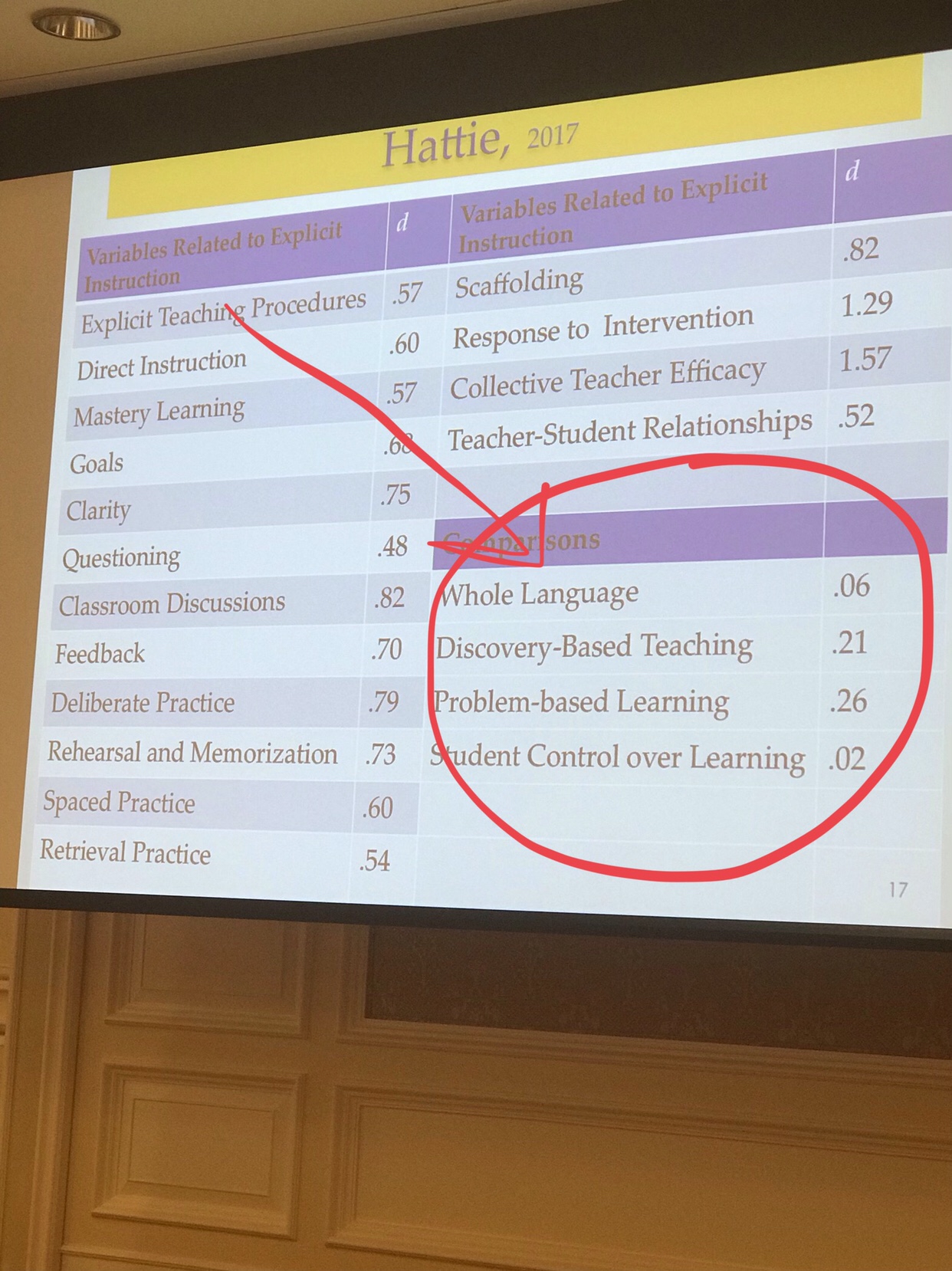
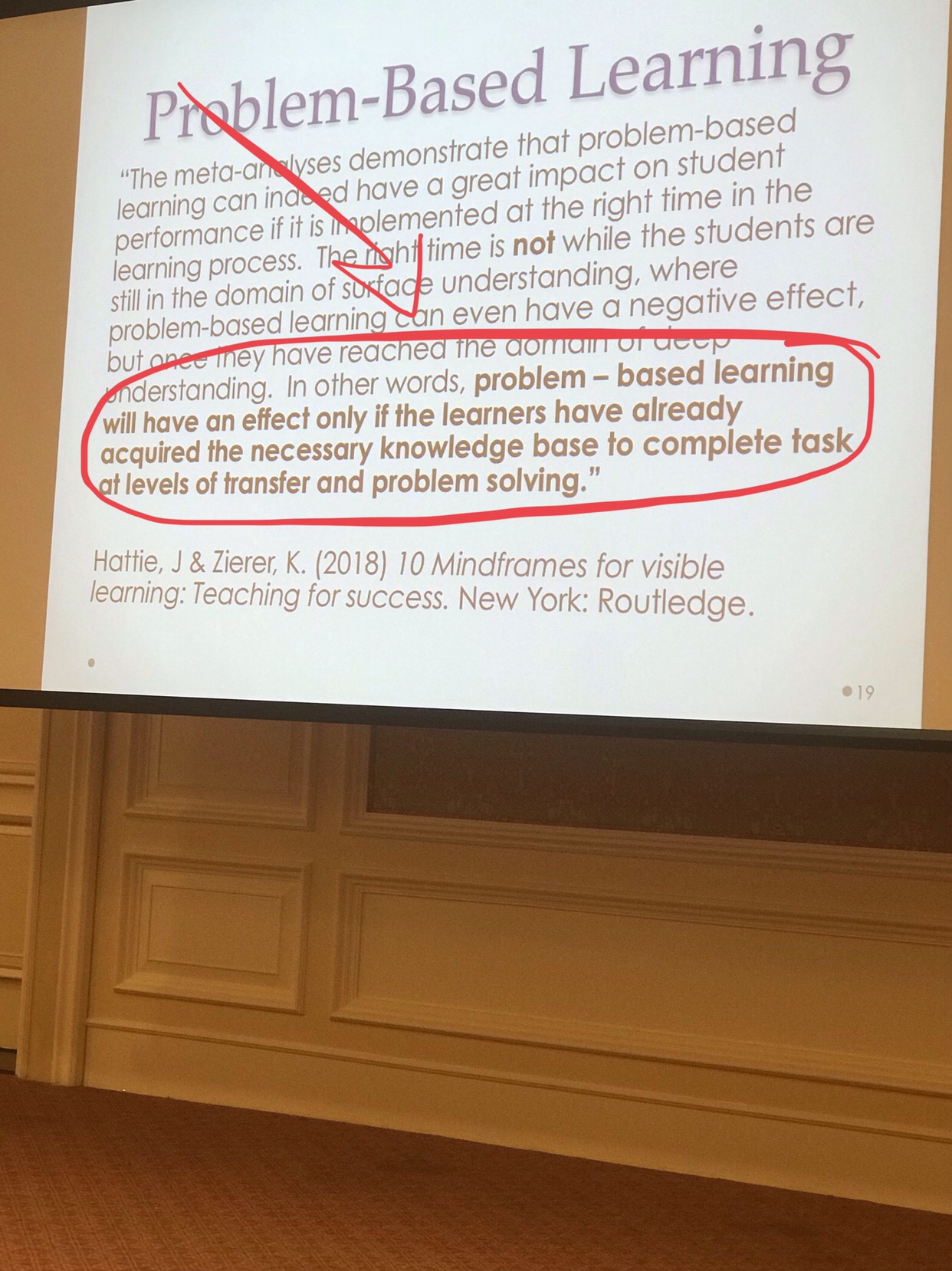
To be clear, I am not suggesting we ignore the areas where our children need additional support. What I am suggesting is that we look to what we know works and find ways to replicate effective practices to address said deficits instead of the addition of new pedagogies that are somewhat experimental in nature when we have yet to see evidence that that the newest innovation works for our students. I was particularly moved last week by a workshop I sat in led by Dr. Anita Archer at the MTSS Innovations Conference. Dr. Archer spent several hours talking to us about the high yield and effective learning strategies and pedagogical methods that are supported by evidence. One particular item she highlighted moved me a great deal. It was a slide with some of John Hattie’s effect sizes for various teaching practices.

When I saw the effect size for problem-based learning I was immediately moved to share the information. I’ve read Hattie’s book, Visible Learning. It’s a critical read for anyone who intends to be an instructional leader. Dr. Archer went on to clarify that there are some critical pre-requisites for problem-based learning to be effective and to me, therein lies the often missing pieces.

She went on to highlight nine essential teaching strategies that can support reducing the variation in instructional effectiveness in our classrooms. I’ll be sharing those in a later post, but many of them can be found in the tool my colleague and I developed: Elements of An Effective Lesson

We’re at a critical point in public education and there is a grave need for us to shift the conversation, the narrative, the mindset, and the work. Our focus needs to be centralized in how we replicate what is working for our students. Our efforts must be driven by their needs and their learning. Far too often, the high stakes assessment environment leads us to abandoning what we know students need or rejecting a concept we know is effective for learning because we are unsure if it will manifest on the test. We must have the courage to do what is best for our students to learn and to improve the practices of teachers. We are professionally and morally obligated to be loyal to their needs well before we are loyal to any high stakes test. I dare you to be courageous!

Until next time! Be you! Be true! Be a hope builder!

Latoya

@latoyadixon5

Honoring the Legacy of Septima Clark & Other Unsung Heroes in the Fight for Equity

“It was time that Negroes were treated equally with whites, time that they had a decent school, time for the students themselves to do something about it. There wasn’t any fear. I just thought — this is your moment. Seize it!”-Barbara Johns, Civil Rights Activist, 1935-1991

Equity has been a central theme in the education of American students since the earliest times. Well before the landmark, Brown v. Board of Education case in 1954, there were many others who expressed concern and raised awareness that separate was inherently unequal. This advocacy was carried by many educators and other external stakeholders who elected to become active participants in the fight for educational equality. Today, as America faces an increasing number of segregated schools, educators have a new opportunity and moral obligation to honor those who carried the fight for equity long ago, for the sake of the country’s children. In Alexander Nazaryan’s, March 2018 Newsweek article titled, School Segregation In America Is As Bad Today As It Was In The 1960’s, he notes:

“Charlotte, [NC] in 2018, looks like most other American cities, where schools are nearly as segregated as they were before the 1954 Supreme Court decision of Brown v. Board of Education, which declared separate but equal schools to be unconstitutional. Some cities, like New York, never really integrated their schools, hiding for decades under the guise of Northern liberalism. Many others complied with court orders, but did so unwillingly and incompletely, without ever convincing people that integration was a public good.”

The advocacy of educators has been central in bringing about change to the American educational equity landscape. If educators like Septima Clark and Sue Cowan Williams Morris had not seen themselves as having a key role to play in bringing about such change, the change that eventually was ordered to occur based on the 1954 ruling in Brown v. Board of Education may have been delayed or possibly could have not occurred at all. Their bravery, courage, and conviction is to be admired, but most of all educators must honor their legacies by becoming advocates themselves.

Sue Cowan Williams Morris began her career as a teacher in Little Rock Arkansas in 1935. In March of 1941, a petition was filed with the Little Rock School Board demanding equal salaries between Black and White teachers. When the board failed to make changes, Morris became the plaintiff in the lawsuit, Morris v. Williams in 1942. The suit requested a balancing of the salaries between Black and White teachers. Morris lost that case, but went on to appeal the decision. In 1945 the Eighth Circuit Court of Appeals in St. Louis, Missouri overturned the initial case ruling and decided in her favor. Morris was then fired as was the principal of her school. Seven years later in 1952, she would get her teaching job back, but only after a call from then-superintendent Harry Little, asking if she had “learned her lesson”. She taught in the Little Rock School District until 1974, when she retired.

Septima Clark was a South Carolina educator and civil rights activist. She began her teaching career in 1916 on Johns Island in South Carolina. Motivated by the racial disparity between the salaries of Black and White teachers and school facilities, she became an advocate for change. She went on to teach in Charleston, South Carolina and played a key role in changing the policy that prevented Black teachers from working in public schools. In 1919, Clark joined the National Association for the Advancement of Colored People (NAACP) and worked tirelessly to get the city to hire African-American teachers. In 1945 Clark along with the NAACP, was represented by Thurgood Marshall in a case that sought equal pay for Black and White teachers. When the case was won, her salary increased by three times as much. Clark’s internal urging to challenge the status quo did not end here. When South Carolina made it lawfully illegal for public employees to belong to civil rights groups like the NAACP in 1956, she refused to rescind her membership and was fired. Her advocacy didn’t end there although her teaching career had been brought to a halt in the Charelston County School District. She went on to labor tirelessly as an educator at The Highlander Folk School which later became known as the first citizenship school because of its centralized efforts on literacy and voting. Highlander’s Citizenship School program helped people learn how to instruct others in their communities in basic literacy and math skills, and as a result more people were able to vote, despite the literacy tests that many states used to disenfranchise African-American voters. Clark is often described by various scholars as calm, yet unafraid, and fiercely brave in her advocacy for equity.

Today’s educators have a moral and professional obligation to channel the courage of heroes like Clark and Morris and work tirelessly to bring equity to America’s schools. A perpetual discussion on the achievement gap should not exclude the importance of educators who advocate for equity. There is a false narrative that the gap is a sheer result of low expectations and minimal efforts. Conversations abound about how educators must not make excuses, but be held accountable for the performance of ALL students. This accountability focus, however, must be a comprehensive and shared one. Educators have a duty to bring this conversation to light about how segregation is still negatively impacting the academic achievement of Black and Brown children. This is not a simple exercise in raising expectations and rigor. Access and opportunity are central to providing ALL students with the education they deserve and in closing the achievement gap output that is often highlighted while the inputs of such remain in the shadows.

We honor the legacies of folks like Clark and Morris when we raise our awareness, we speak up, and we commit to serve in ways that help change the educational equity landscape in this country. Clark and Morris did not wait on those who set the policies and developed the law to change them. They saw themselves as instrumental in bringing about change. Today’s educators must start by seeing themselves in the same way and only then will we honor the legacies of those who came before us.

Until next time-be you, be true, be a hope builder!

Latoya

@latoyadixon5

From Idea to Execution: The Follow Through of Leadership

Lately, I’ve been thinking a great deal about how some leaders exhibit an extraordinary strength in setting the vision, creating ideas, etc. yet struggle greatly with the actual execution of those ideas. Others aren’t the best at creating a vision or coming up with an idea, but given a directive and task to complete and see through, they have a strong ability to execute as directed. I’m left with this intellectual dilemma: Why is that some leaders are good at creating ideas, yet struggle with execution or vice versa?, and How is it that some leaders are great at both?
I’ve seen a great deal of leaders who view themselves as task masters, managers of the work, accountability officers, etc.  Their concept of leadership is one that meets the age-old adage, “Someone has to be in charge”. They see their job as one in which they assign tasks, delegate responsibility, and hold others accountable for getting the job done or the execution of those tasks. Others however, conceptualize leadership in a much broader and abstract way. They view themselves as the person who creates conditions to allow others to come up with their best ideas and execute them, to set a vision for what the organization or their department could be, to be forward thinking and innovative, anticipating how to make the organization future-focused and driven by what is to come instead of maintaining what has always been. 
As I continue to study great leaders and think about what makes a great leader, I can’t help but think about this tension between project management and innovation in the education realm, specifically, in educational leadership. The value of being a visionary in the business world seems far more acceptable and expected. Those innovators and visionaries who are seeking to anticipate what the future looks like in education and working to design their districts, schools, and classrooms in a way that readies students and staff for what they believe is on the horizon aren’t always received well. What is known as innovation in the business sense becomes a disruption in the education sense. Why is this?
In Clayton Christensen’s book, Disrupting Class: How Disruptive Innovation Will Change the Way the World Learns, he notes: “Motivation is the catalyzing ingredient for every successful innovation. The same is true for learning.”  This leads me to ask, what has traditionally served as the motivation for educational leaders and what is the critical ingredient that motivates them now? Is it personalization of learning for every student? Is it having high test scores? Is it being able to quantify efforts by taking on multiple initiatives? I can’t help but wonder if we have somehow dismissed the importance of the need for educational leaders to also be innovative. By calling innovation disruption, we’ve almost perpetuated a rebel mentality. That is, those in education who go against the grain, who push for something different, are often seen as disrupters rather than innovators.  They are often victims of being seen as overachievers, not fitting in, or just plain causing trouble.
Here’s what we know all too well. Educational leadership is far more complex than project and task management. It’s more than the ability to delegate and hold others accountable. The future of this field belongs to those who are willing to take incredible risks, to do things differently because they have the potential to be more effective or efficient, to innovate, not disrupt. 
Innovators have both skill sets. They bring ideas and a vision to the table along with the ability to execute. They are future focused, yet utilize the best and worst lessons of the past to drive their efforts. What are the implications of this for educational leadership preparation programs? Is there an opportunity to prepare leaders as forward thinkers paired with the traditional management approach and coursework? If we want educational leaders who prepare students to be innovative collaborators who can compete in a knowledge economy and global society, they will need leaders who can do the same.
Until next time-be you, be true, be a hope builder!
Latoya

Advancing Educator Practice: Moving Beyond High Expectations

School reform efforts have come along fast and furiously in the last twenty years. They’ve included high and aspirational goals for student achievement and for closing the achievement gap. Some have been accompanied by consequences that place grades on schools as a measure of their performance while others labeled schools in a way that made their need for improvement publicly transparent. From 1983’s A Nation At Risk to the rhetoric ridden No Child Left Behind to today’s Every Student Succeeds Act, one glaring approach has been missing from all of these reform efforts and policies.  While each policy has centered on improving student achievement through high expectations, aspirational goals, accountability via tough consequences, none have focused on the most important mechanism in advancing learner outcomes: improving the practices of teachers.

Here’s what we know about instructional effectiveness but have yet to capitalize on as a nation: 1. There are high yield strategies that lead to improved instructional quality and learner outcomes. John Hattie’s work, Visible Learning, illuminates this. 2. Teachers need quality and robust feedback and coaching support to improve their practices. A simple demand for improved test scores and achievement hasn’t been and will never be enough. 3. Creating a more equitable way to provide professional development and resources aligned with the goals for improvement could be a game changer. As much as inequity persists for our students and their educational experiences, those same inequities plague the professional development of practitioners who serve children in our poorest and neediest communities. This too contributes to the ongoing achievement gap between our wealthiest and poorest and Caucasian and minority students.

Teacher quality isn’t a new concept. It has been on the minds of educational scholars, leaders, and the like for many years. Yet, very few of our reform efforts focus on how to advance the quality and effectiveness of instruction that children receive. Instead, we see evaluation as a way of weeding out poor teachers, and in many cases, those who are deemed “effective” are deemed so early on and rarely provided with the feedback, support, and development opportunities they need to sustain their effectiveness. Additionally, there are learning trends and fads that seem to plague the profession, yet give little credence to the foundational and effective pedagogical strategies we know result in improved teacher practice and learning outcomes for children.

Further, we are plagued by a quantitative view of tallying our classroom visits, keeping track of how many inquiry-based lessons teachers are incorporating, instead of placing our focus on the feedback teachers need to perfect their pedagogy. By focusing on feedback and ways to advance the practices of educators, leaders have an opportunity to significantly impact learner outcomes in a positive way. Instructional leadership requires the ability to help those who are delivering the instruction to be able to do so in more effective, efficient, and innovative ways. Providing a judgment of an overall lesson as good, not so good, etc. doesn’t help advance the practices of teachers. It’s precisely what happens beyond that final judgment that can make the next lesson more effective.

This presents an additional opportunity for our school leader preparation programs. How do we move aspiring leaders past the management of the books, buses, building, finances, and people? How do we help leaders learn and prepare them to be ready to advance the practices of educators? How can practicing school administrators improve the quality of the teaching students experience in their building? I believe that ability does not come from evaluating poor performing teachers out of the profession, subscribing to the latest trends, or keeping a quantitative monitor on the number of initiatives in your building, but from having deep instructional knowledge and the ability to share and teach other educators how to improve the quality and effectiveness of their instruction by using high yield learning strategies.

In spite of every well-intentioned and well-named reform, we’ve not changed outcomes in the ways we so often say we desire. If we intend to advance the outcomes of America’s learners, we must begin by focusing our efforts on how to improve the practices of those who are serving them.

Until next time…be you, be true, be a hope builder!

Latoya

@latoyadixon5