Public Education’s Pandemic Opportunity

“Let’s be good stewards of the unknown by embracing this time as a time to reimagine our profession, to bring back the joy to teaching and learning, and to do what our children need us to do: be steady. This will not be an easy task and it won’t be perfect. Let’s all lead during this uncertain time with the certainty that our profession and public education is a cornerstone of America’s democracy.”

From my blog post, Leading In Uncertain Times: A Call for Unity, July 26, 2020

There should be no doubt now. There should not have been any before the Corona virus took hold of our lives, our work, and our socializing. Public education is an essential cornerstone of American democracy. Our approach and operation moving forward must be one that honors the clear indication of the needed change to the way we conduct teaching, learning, and leading. Here are a few insights that come to my mind in this regard.

1. Leaders must become comfortable and competent at leading change. The future of public education is uncertain and the ability to adapt to the social and structural changes occurring in our world is going to be a critical component in leading effectively. Leaders who are future focused, visionary, and willing to utilize innovation and flexibility to produce better outcomes for both students and staff will outlast those who maintain a fixed mindset centered heavily on the management of people and operations rather than the creation of new opportunities and experiences.

2. The voices, needs, interests, and passions of students must be honored in the way we approach the teaching, learning, and assessment practices. Caring and trusting relationships and authentic connection with each student is of critical importance. If we don’t provide students with the personalized experience they desire and deserve, they may seek other avenues to equip themselves with the skills, knowledge, and characteristics they need and desire. Students will demand and develop a sense of community with or without pubic education’s invitation. To combat this, we must work to ensure a sense of belonging and affiliation for every student we educate coupled with opportunities to demonstrate their knowledge and skills in authentic ways.

3. The post-pandemic successful teacher must be provided with personalized professional learning opportunities and given the flexibility to innovate in his or her classroom. Further, the voices of teachers must be honored in what we ask of them and how we support their efforts to provide students with high quality, meaningful, and relevant learning experiences. These teachers will demand a sense of community and an opportunity to lead from their classrooms to improve their professional experience and the learning experiences of students.

Our ability to look forward towards a brighter and more equitable future in public education matters more than it may have ever before. The consequences of missing and failing to seize the opportunity before us are large and serious. Let’s make sure we’ve learned from our past, but more importantly, let’s ready ourselves for a better future for all of our children, those who serve alongside of us, and do so by redefining success for ourselves and our students.

Until next time-Be you! Be true! Be a hope builder!

Latoya

An Open Letter to America’s Educators for the 2021-22 School Year

Hey y’all,

I hope you are all taking some time to relax, refresh, and rejuvenate your mind, body, and spirit this summer. After teaching and leading during a global pandemic, I believe self-care isn’t just a good idea, but necessary to be your best self. If I’ve learned nothing else during COVID-19, I’ve learned to protect my mental health and to take mine and that of others seriously. Our wellness-mind, body, and spirit-matters.

But that’s not why I’m writing this letter. I’m writing to plead with each of you. Please promise me that you will not return to the past, “go back to normal,” or relish in the comfort of teaching, learning, and leading in the same ways you did pre-COViD. I feel compelled to remind you of the enormous opportunity we have before us. We know that many of those practices and routines we were allegiant to pre-COViD were not working-for our students, our families, or us! Yet, it can be so tempting to seek comfort, and especially so in times of uncertainty.

I’ll be the first to admit it: the future of public education is unclear. However, I hope we embrace this as a chance to create the future we know our students, their families, and our fellow educators so desperately need. This is an opportunity to finally abandon a system of mass learning, teaching to the middle, and conditioning students to care more about their G.P.A. than their passions. Let’s use this as an opportunity to design an education system that helps children find the intersection of their most competent skills and passions, to design meaningful and relevant learning experiences, that have timeless value and enduring lessons.

I know what you’re thinking. How do we do that? What about the tests? What about school report cards? What if it doesn’t work? What if we fail?

I’d like to counter those thoughts by asking these questions: Why not? What if we improve the system for all involved? What if we redefine success? What if we create a new way of thinking about public education, it’s’ purpose, and value? What if we create a spark that draws the best and brightest minds to our profession? What if are children end up more ready for life that they’ve ever been before?

As much as we find comfort in routine, I hope we find the courage and execute the bravery it takes to chart a new course. We are either held hostage by our fear or made free by our courage. I’m choosing courage. Who’s with me? Our children deserve it. Our families deserve it. Our profession deserves it. We deserve a new day in public education. Look forward!

Until next time, be you! Be true! Be a hope builder!

Latoya
The Power of Pausing

The last three weeks have been an important time for me. I’ve had an opportunity to pause from the daily grind and routine. I knew I was in need of it, but I had no idea the extent to which I needed a moment to clear my heart, my mind, and be still and quiet. For the first time in a very long time I did not present at the South Carolina School Administrators Summer Leadership Conference. Instead, I was able to spend my time reconnecting with others I had not seen in person in quite some time, attend sessions as a learner, and make new connections as well. At the start of June, I was talking with a friend about how exasperated I was feeling, and I shared with her that I was uncertain if that feeling was due to COVID-19 and working during a pandemic, over extending myself in my desire to help anyone that asks for assistance, or if I was just in a season of being overwhelmed that was lasting a bit longer that I desired. My friend very simply encouraged me to put boundaries in place to take care of myself and to provide myself with time and opportunity to receive as much as I was giving to other people, work, and areas in my life. I needed to pause and be still. My mind, body, and spirit needed a clearing and a reset. The last two weeks have been exactly what I needed, and I’ve learned so much from pausing that I felt compelled to share it here in this blog post.

To clarify, pausing and stopping are not synonymous. There’s an important distinction between the two words that needs to be acknowledged. To stop means to come to an end, to close, but pausing is a brief interruption. Pausing allows us to remain engaged and committed to our purpose and life’s work while simultaneously taking a brief period to renew our mind, body, and spirit in ways that feed our hearts and souls what is needed for us for us to continue it journey. Think of a hiker who desires to complete an arduous trail hike. Pausing for water, food, or to observe nature allows for rest and renewal, and without it, the hiker’s ability to finish the journey is compromised. Leaders must do the same thing if we intend to complete our journey.

Secondly, pausing allows us to be fully present. When we are not at the mercy of email, the next meeting, the next due date, or deep in the throes of planning for the next big assignment, we can be fully present. Our undivided attention can be given to those things which are most important. We can fully engage without a lingering feeling that we are compromising our dedication to all the other things we need to get done. What a gift it is to be able to be fully present and in the moment. When we spend too much time anticipating what’s next, we can miss some of the most powerful experiences and interactions in our lives.

Finally, the benefits of pausing and what it can do for us afterwards is far more valuable than I ever realized. I feel with great certainty that my professional and personal interactions will be approached with a greater sense of positivity, and that my productivity levels will be much better than they would have been had I not had an opportunity to simply still my mind, body, heart, and soul.

I want to encourage leaders near and far to be sure to recognize when you need to press pause, and even more so be willing to do so. The people we are called to serve, care for, and lead will thank you for it, and you may find that you are a better and more present leader when you press pause too.

Until next time, be you! Be true! Be a hope builder!

Latoya

A Moment of Clarity

I’ve been spending a lot of time reflecting and thinking over my last 22 years in education recently. I’m not sure if it has been initiated by COVID-19 and the challenges educators faced this school year, the last 18 months in my new position, or just the journey of life that pushes us along with age and experience. But what I now have concluded and know for certain, is that it’s time for me to explore, innovate, grow, and move forward on my own terms.

I’ve gained so much clarity about my journey which is far from over, and here are a few of my latest thoughts:

1. Don’t waste time waiting. If your value isn’t being seen and added to, move your feet.

2. Because time is so precious, I can no longer engage in inauthentic relationships, personally or professionally. My time and my talent are too valuable for meaningless interactions and surface relationships.

3. Investing in my own development must be a priority. I must balance the pouring out to support others with pouring into my own growth, and use boundaries to help make sure things don’t get out of balance.

I’m clear about that and ready to move forward with purpose. I encourage all of us to think forward, and caution us all to not spend too much time reflecting or living in the past! Time flies, but it doesn’t move backwards!

Until next time, be you, be true, be a hope builder!

Latoya

Education-An MVP of the Pandemic

This morning I participated in a Twitter chat, #pd4uandme after a little nudging from a colleague. The conversation was about naming educators in our lives who we saw as Most Valuable Players this year. I struggled to identify an individual because the year we’ve had in public education leads me to believe that every educator has been an EDU-MVP in the wake of this pandemic. I tried to think of one EDU MVP and immediately my mind was flooded with so many people, starting with my work family and all the way to my Edu PLN. It’s just too big to name one person. It’s been tough, but we’ve managed…by staying CONNECTED. Education is one of the Most Valuable Professions and has proven itself so during this pandemic.

I hope the spotlight on public education continues to shine in a way that honors our worth, promotes the recruitment & retention of excellent educators, & continues to elevate the profession-when the pandemic is over. Educators are integral to our democracy!

I hope folks will talk about the way educators stepped up and learned to pivot at a moment’s notice as much as they talk about learning loss. Our students need us and we’ve got work to do, but let’s be clear: It’s not because we haven’t put forth exceptional effort.

If I were forced to give an EDU-MVP award, I’d give it to the profession as a whole. When crisis arrived, we answered. We taught-by computer, cell phone, tablet, in 😷, provided meals to students & families, & mental health & SEL services. This shouldn’t go unnoticed.

When I think about how valuable educators have been to society during this pandemic & how valuable we are in general, it brings me great sadness to think we were first to serve, but in many cases will be last to be vaccinated. Our profession deserves better.

I don’t mean to get on a soapbox & don’t care to debate. I just hope we are the topic in conversations about how to honor, elevate, and uplift our profession post pandemic-not just in the ones about how we’ll be punished if the children don’t do well on the test.

We’ve proven ourselves to be much more than test scores.

Until next time, be you. Be true. Be a hope builder!

@latoyadixon5

The Truth About Leadership: Part 3 – Resilience Is Required

One of my biggest challenges as a leader has been strengthening my resilience. From the outside, it may appear that I have approached challenges with vigor and persistence, pushing through tough situations and times with a smile. On the inside, there’s a different story. I’ve had to learn over the years not to replay my mistakes in my mind over and over and over again in an attempt to analyze where things went wrong. It’s taken me some time and a ton of experience to understand that healthy reflection includes resilience instead of a long period of deep self-disappointment. Acknowledge the error. Make note of what you could have done differently. And most importantly, move on, and do so with haste. In the early years of my leadership, mistakes seemed to linger longer than they should have and in ways that were not productive. I struggled greatly with being a perfectionist and became a pro at worrying about everything and anything. In 2017, I found myself in a toxic relationship with worry. Even now when I tell folks that they tend to look at me rather puzzled. They almost always say, “I’d never know it. You seem so confident.” But we all know things are not always as they seem. While my confidence is at the best level it’s been in my leadership journey, it hasn’t always been that way. I remember turning 40 in 2017 and thinking that I had spent what could potentially be half my life worrying, and on my birthday I decided I’d worry no more. My relationship with it had made me a leader who lacked resilience and I began to focus on bouncing back rather than being all consumed with making an error.

Here’s the truth about leadership: If you are a leader, you are going to make a mistake. The best thing you can do is spend time working on how you will move on and beyond your errors rather than wallowing in them. Analyze your relationship with reflection and make sure it isn’t toxic. We have a tendency to misrepresent what it means to be a reflective practitioner. Here’s what it doesn’t mean-over indulging in guilt, which can manifest into self-doubt and a lack of confidence. Self-doubt and humility are not synonymous, and all too often leaders operate as if that is the case. Humility means you recognize everything is bigger than you, including your purpose, and it is precisely the reason we ought to be more resilient in our leadership journey.

As a young student in elementary school, my teachers often wrote about how conscientious I was-it’s how I learned what the word meant (report card comments). It’s my nature. I want to do a great job and I was reared to always do my very best. Momma wasn’t having it any other way. But I have finally learned that my conscientiousness cannot be a handicap to my confidence. Leaders must believe in themselves, and we demonstrate that by practicing vulnerability and resilience in equal measure. It makes us more authentic and most importantly, it gives us freedom rather than fear. And we all know that freedom feels better.

Until next time, be you. Be true! Be a hope builder!

Latoya

@latoyadixon5

The Truth About Leadership

This is part one of a multi-part blog series. If you are so inclined, I welcome your feedback.

I’ve been thinking about something lately that I can’t seem to get off my mind. It’s the idea that too few people write honestly about leadership. It’s all sunshine and rainbows, but not really. The truth is that leadership is incredibly hard. It is challenging, some days more than others, and it does not always feel great or good. Sometimes it can feel scary or unnerving and other times it can be purely exhilarating and full of joy. But nobody writes about the scary and unnerving times. It’s all about how to be great, how to lead with courage, how to set a great example for others to follow. Sure we all need encouragement and being positive is necessary, but sometimes I just want people to tell the truth about leading. It is tough, and the only way out of the tough parts is through. I’m not going to wait any longer for someone to be real and write about the rawness of leadership. I’m doing it. Here goes nothing. In this blog series, I’ll be writing about the hard parts of leadership because there are too many leaders who feel alone in their experiences because so many simply won’t tell the truth.

Nothing is more demoralizing than a leader who lacks authenticity. One who does the things they think they are supposed to do because they want to be sure they live up to the idea of leadership that others promote. During my time in leadership, being committed to being authentic has been a blessing and a curse. Some appreciate it. Others are uncomfortable with it, and usually they are uncomfortable with the opinions others have of them as well if they aren’t all glowing and positive. But the truth is that if you are a leader, you can guarantee that you will be criticized, not liked by some, and it will not feel good. I’m not writing to tell you that you should not care when others don’t care for you. I’m writing to tell you that it is normal to feel concerned when others criticize your decisions, your leadership style, etc. But that concern doesn’t have to be coupled with conformity. Want to get yourself in a rat race that you’ll never win? Try pleasing everyone. You’re sure to burnout fast. By doing what you believe to be the best thing for the people in your organization and those you serve, you lead. You stand on what you believe in and you accept the criticism where it is warranted and respect the differing opinions of others as leaders should. But make sure you don’t fall victim to losing your authenticity as a leader-what makes you….YOU.

In my experience, I’ve had the opportunity to work with and observe many leaders. Time and time again, I’ve watched folks lose themselves in their leadership. Either taken over by ego or reduced by a few loud voices of criticism, they begin to not even recognize themselves. While leadership and the experiences that come with it are sure to impact you, and if powerful enough maybe even change you, your core values must remain solid. The moment you find yourself shifting in what you believe to be right, just, and equitable for all, or consider taking action in a way that contradicts what you believe, you must reconsider your leadership journey. It could mean you aren’t in the right environment or it could mean you’ve allowed the pressures of leading rather than the privilege of leading to drive you. Because leadership is a privilege, and those who lead should never forget that. In those times when I have faced criticism, I’ve had to work to remain balanced and find the sweet spot between taking it too personally and disregarding it all together. It’s the middle ground of giving consideration where it is warranted, but not allowing it to produce a level of self-doubt that negatively impacts me and my ability to lead that has worked best for me. And finding that balance is a never ending journey.

Real leaders reckon with remaining authentic and true to themselves all the time. I am not sure why few share this experience and so many resort to telling the sugar coated stories of leading. My leadership journey, while full of great experiences, has equally been filled with sleepless nights, stressful days, anxious nerves, wonderings of regret, fearful and tearful moments and conversations, and more. That’s because leadership is hard. It is not easy, and it is especially not easy if your greatest goal is to be an authentic leader who accepts yourself, your flaws, your mistakes, your errors as well as you accept your accolades and accomplishments. This is a mammoth task. It requires a level of personal and professional security that is solid enough withstand the winds of change, the voices of criticism, and the uncertainty of it all.

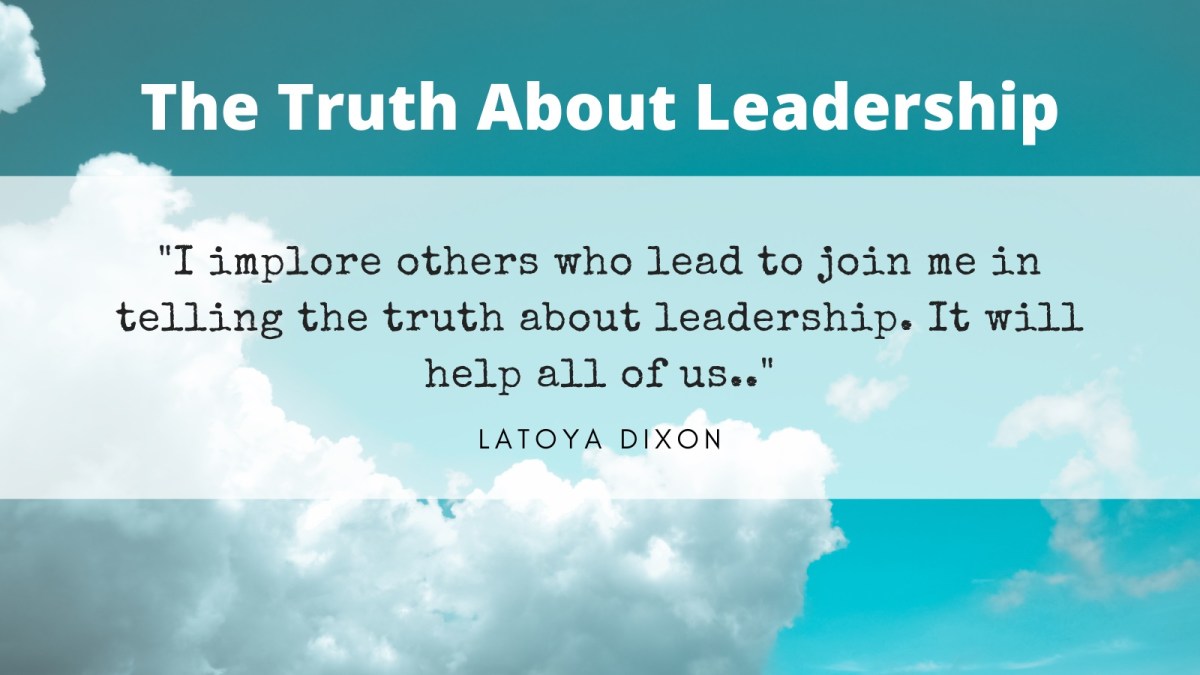
But I am determined to be as authentic of a leader as possible. I’m not afraid to admit that leadership is the hardest task I have ever embarked upon, and it’s been a challenge at every level, big or small, school, district, or state. However, I recognize that what has kept me in it is remaining true to myself, my core values, and real in my relationships with others. That is the stabilizing force in the journey-the authenticity- of it all. I implore others who lead to join me in telling the truth about leadership. It will help all of us.

Until next time, be you. Be true! Be a hope builder!

Latoya

@latoyadixon5

Purposefully Present

Like many of us, my mind has been accustomed to anticipating the future and making decisions as a leader that best prepares the team for what is likely coming next. In fact, I find a great deal of comfort and pride in my ability to be forward thinking and believe it to be one of my best skills. But this time that we are living in has changed that. None of us can predict, with any level of certainty or confidence, what may be coming next. Stability can only be found in being sure that life, work, and play as we once knew it is in an ongoing cycle of change. Change is the new constant. And if change was difficult for humans pre-COVID, we can all expect this time period to be one of the most challenging and significant periods of our lifetime.

I’d be remiss if I didn’t share how disruptive this has been for me personally and professionally. And I believe this to be true for almost all of us. Disruption causes discomfort, but in an attempt to shift my thinking I’ve been reminded that it can also be the birthplace of innovation. I am choosing to see it as an opportunity to reinvent myself, to reinvent how we do the work in public education, and ultimately, create a better and more equitable system for all children. It seems that even with knowing we were in the midst of a public education system riddled with too much standardized testing, not enough social emotional learning or personalization, many of us find ourselves longing for what we knew-even though we know it wasn’t the best way to support and lead teaching and learning. It’s a classic lesson and it teaches us that every thing that is comfortable to us isn’t good for us. And without being forced to take on a new perspective, many of us would not be able to let go of the past-no matter how unproductive it has been for many students and educators.

Reinventing ourselves can be exciting work. We get to start over and clarify our values and beliefs. We can create healthier and happier versions of ourselves. We can make our work what we desire it to be instead of feeling stuck in a system that we know doesn’t work for all children. But this period of significance can also be accompanied by fear and anxiety. Not knowing is the height of discomfort and that is why we must solidly rely on what we do know. I am choosing to concentrate on those eternal principles that will never change: 1. Relationships matter a great deal. In the end, it’s our relationships with others that carry us through and make our lives meaningful. I intend to use this pandemic to create and build on those friendships and relationships that matter most to me. 2. The needs of the children must come first. With all the conversation regarding learning loss, it’s easy to gloss over those other needs-safety, security, food, shelter, hope-that our children all have and may even be heightened as a result of this pandemic. When we stop to ask ourselves what it is that our children need, we need to be gut level honest. We cannot make their social emotional needs less important than their need to learn. Both matter a great deal, and quite frankly it is about both need and readiness. If we don’t work to be sure our children are ready to learn, we will miss the opportunity to meet their need to learn. Let’s not assume that the only need for our children is to recover the learning they’ve lost. We all know being academically successful is built on a foundation of Maslow’s hierarchy of needs. We need to be attuned to that with a precise focus. 3. The most difficult work can only be done successfully if we work well together. Collaboration is necessary for success, and during this time I find it to be essential. If we aren’t pulling our team together to share the load, engage in powerful discourse about next steps, and support each other, we can be sure that we’ve succumbed to an approach that is purely centered on surviving. As hard as things are, we need to survive and thrive, and in my mind the thriving part has never been more important.

I am hopeful that we can all take this opportunity to reinvent ourselves and our work in ways that benefit us and those we serve beyond this pandemic. My goal is to come out happier, stronger, and a better leader than before. To do that, I’ll have to let go of my need to anticipate what is coming next and focus on being purposefully present-enjoying every good and happy moment life offers, making the most of my experiences, and finding joy in knowing that moving through this pandemic one day at a time is more than o.k. instead of thinking ahead. I’m committed to being purposefully present and collecting all the joy I can find.

Until next time, be you. Be true. Be a hope builder.

Detoxing: A mind, body, & spirit experience.

During the time I have been detoxing from social media, I have found myself alone with my thoughts. I can’t fill the empty spaces with scrolling or reading a feed of some sort, so I sit and I think, and reflect, and gather my feelings. It’s amazing how much social media can add to our emotional lives and at the same time, lead us to a place where we know our feeds better than ourselves. In this month of cleansing my mind by taking a break from social media, journaling, and meditating, I have found myself nose to nose with some of my deepest fears, aspirational goals, and emotional needs. I can’t hide from what’s inside by distracting myself by absorbing the thoughts, opinions, and reflections of others posted for all to see. In this season, I am alone with my thoughts and feelings. And for now, I think that is a good thing.

I’m not one to watch much television, so aside from my binge watching of Season 5 of Greenleaf in two days, I’ve sat quietly quite a bit. Sometimes sitting outside staring up at the clouds and letting my mind be free from its’ usual distractions. Other times, sitting on the couch and taking a minute to just be still. Something I rarely do as my type A personality views time spent idle and unproductive to be one of life’s many ways to practice a lack of discipline. Yet, I have found that this time of stillness has been much needed. It has helped me to clarify what is important to me, to set my intentions around how I wish to spend this next phase of my life, my career, and determine which personal relationships I need to nurture more. I remain a solid believer that my need for deep, meaningful, and authentic relationships is at the core of who I am, and there is no substitute for that-social media included. I need human interaction, and it appears it may be more beneficial for me to invest more consistently in those relationships and friendships no matter how few they may be in quantity.

I recognize that our empty moments, a minute filled with silence, a pause in the daily grind of life does not have to be filled with scrolling, trolling, or news feeds. It’s more than ok to be still. It’s required to think clearly, to live with intention, and to stay true to one’s self.

I’m posting this blog using an automatic button on WordPress that will post it to Twitter for me, but I won’t be back on social media until next month. And somehow, I know I’ll be better for it in all ways possible.

Until next time, be you! Be true! Be a hope builder!

Latoya

Leading Thru Uncertain Times: A Call for Unity

My journey in leadership has not been without challenge, and I’d be dishonest if I said there weren’t times when I was uncertain about my abilities. With experience, both the good and the bad, I’ve learned that doubting yourself every now and again isn’t abnormal. In fact, it helps keep you humble and lead with the same grace you want extended to you when, not if, you make a mistake. If there’s one thing I’m more comfortable with now than ever before, it’s the realization that perfection is not required of leaders. For many of us, we enter this work believing that our job as the leader is to make sure errors don’t happen, to remove obstacles, to avoid pitfalls, and do it all with flawless execution. Nothing could be further from the truth.

While it has taken me many years to come to this realization, I now know that our job is to demonstrate grace under pressure, to set an example of what resilience looks like when things go awry, to be the steady in the times of uncertainty, giving those we serve comfort and reassurance that things will improve and eventually, all will be well. That’s true leadership. It’s our ability to deal with imperfection, uncertainty, and the unexpected that makes us leaders.

In this present time of a global pandemic, this ability to lead under pressure, could not be more important. The country is looking to America’s educators to help return society to the first step of back to normal. Understandably, many educators, like parents and children are afraid. We are living in a world of unknowns, and the lack of control we now have over our everyday lives and our ability to protect ourselves and our loved ones is considerably different than it used to be. Dealing with COVID-19 hasn’t been easy for me. My socialization has been severely restricted. I’ve not been able to see my family on a regular basis, and I’ve missed many social events with friends and colleagues as we are all trying to do our part and stay safe. While my natural tendency is to plan ahead, this pandemic has taken away every measure of discipline I’ve worked so hard to establish. But I’m not giving up, and giving in isn’t an option either.

What leaders need to do now, more than ever, is simple. Unite the members of your organization. In a world where a public health crisis has been over politicized, folks are feeling forced to take a side. Instead, we need leaders who can pull the group together with a focus on what’s right-not who is right.We need to turn our attention away from attacking each other about our personal and political beliefs as educators, and apply that energy to those who are attempting to destroy a foundational cornerstone of American democracy-public education. Educators and those who understand that public education benefits our entire society need one voice, and they need it now. I fear that while many are focused on who is right, those who set policy, administer funds, and decide the future of public education will have stripped the very thing that we all love so dearly, and we will have missed it because we were too focused on who was right instead of what was right.

I challenge every leader, from superintendents, to principals, to teachers to find a way to focus on protecting the institution of public education by working to make it look like it can and should be. This is our chance. The uncertainty we are experiencing has opened a door for us to finally move away from a structure that no longer fits the needs of our children or our country. We have an opportunity to think about teaching and learning in new and unprecedented ways. If we are strategic, and more so united, we can do more than preserve the institution of public education. We can make it a system that works for ALL. We can reduce inequity. We can move away from the billion dollar standardized testing industry that drives our daily operations. We can focus on what children really need, addressing the whole child in a way we haven’t been able to before. We can do this.

Let’s be good stewards of the unknown by embracing this time as a time to reimagine our profession, to bring back the joy to teaching and learning, and to do what our children need us to do: be steady. This will not be an easy task, and it won’t be perfect. Let’s all lead during this uncertain time with the certainty that our profession and public education is a cornerstone of America’s democracy.

We’ve got this.