Courage: Resisting the Fear of Failure
As a young child growing up, I distinctly remember the one thing my mother told us about being scared. It was simple and to the point. “Never let fear stop you from doing anything.” That mantra has guided me and given me courage in moments of uncertainty, times of debate when decisions had to be made and I had to decide whether or not to step through the doors that opportunity opened for me. Each time I chose not to allow fear hold me back, my courage developed. I’ve come to realize that that fear has a power to hold us, hostage, in spite of our best intentions, if we allow it to do so. While playing it safe can feel more secure, if we never take a chance we leave our destiny up to question. Who wants to live with a series of “what could have been, might have happened, if I had only…” thoughts.
As I get closer to finishing my book and publishing it, I realize that I’m taking a chance on so many levels. I’m self-publishing, not working with any particular publisher which has its limitations and benefits. I’m investing my own personal money to do so which I’d classify as a high-risk investment. I’m promoting my book on my own, developing a publication plan, and revamping my #leadershipwithlatoya website. In the last year, I’ve started a podcast, produced an e-Magazine, and written a book all while working a full-time job. I’ve done all of this for one reason. I enjoy it.
This past fall, I ran into an old colleague at a local restaurant who said, “I see all of your stuff on Twitter. What are you trying to do?” I responded, “I’m trying to be me. I want to share good stuff with people.” I thought about that question long after it was asked, and I’ve decided that my courage is mine. It belongs to me and me alone. As I get closer to the release and publication of this book, I get nervous about so many things. Will anyone read it? What kind of critique should I expect? What will happen if it’s a total and complete flop? How will I respond?
I’ll respond with the same courageous heart it took to put my thoughts and ideas on paper, to put my vulnerability out in the open, to present my heartaches and passions bare and naked to the world. I’ll respond with the courage it takes to take a chance at living a life with no what ifs and no questions about my destiny because I believe in my dreams and my hopes more than I believe in my fears.
Until next time-be you, be true, be a hope builder!
Xoxo,
Latoya
The Future of Education: A Focus on The Enduring Principles
An Open Letter to Superintendents
This post was inspired by a few recent conversations I’ve had with some friends who are principals and an informal poll I ran asking principals about the stress of their jobs. I surveyed over 250 principals and asked them to rate the stress of the principalship as highly stressful, moderately stressful, or rarely stressful.
84% rated it as highly stressful.
Dear Superintendent,
I am writing to you today on behalf of all of the principals who lead your schools. They are stressed beyond measure and dealing with new and complex problems. The job of the principalship has changed tremendously over the last twenty years.
Are you aware of how much time your principals spend trying to find ways to solve or assistance to tackle mental health issues of students and or their parents?
Do you realize how the success of their leadership is defined by a once a year series of high stakes tests? If students perform poorly, so does your principal. What a pressurized environment!
Do you realize how difficult it has become to find teachers because there is a nationwide shortage and then the challenge in retaining those new to the profession because they didn’t realize how difficult it would be to teach 26 different children on different reading levels, math levels, some with social emotional needs beyond their expertise, some with mental health challenges they didn’t learn how to deal with in their ed prep programs, and some with severe behavior challenges that make learning difficult for all the other children and teaching nearly a miracle some days?
Are you aware that your principals are now working 24 hours a day, nearly seven days a week? I mean, yes there’s the school day, but there’s the quiet of the morning before everyone arrives to get things prepared for the parent conference you have coming up or for the mental preparation for the irate, rude, and threatening parent that you weren’t expecting. Then there’s all the wonderful after school opportunities we have for children and the sporting events until late evening to attend so that your leadership and commitment to the school isn’t questioned even though your own family hasn’t seen you at the dinner table before 8 in weeks, maybe months.
Let’s not forget the weekends you spend writing lesson plans for the long term substitute in the math class for which your principal has not been able to find a teacher. Or the phone calls from parents who need your help with raising their kids, who don’t know what to do about their child’s refusal to listen or oppositional defiant disorder. Of course, the occasional alarm call in the middle of the night that requires your principal to go check on the school and interrupts their already disrupted sleep pattern because they go to bed with numerous problems on their minds that need to be solved but are becoming more complex year to year.
Do you know the stress of restraining a student whose mental state is questionable, but who must be kept from attacking others or the teacher? Do you recognize that you can’t schedule those sorts of things?
Are you aware of how much time your principals spend listening to stressed out teachers whose anxieties are sky high because last year their students didn’t do well on the math test and the last parent conference they had was one in which the parent was downright rude and disrespectful, not to mention the divorce that the teacher is currently going through that isn’t going so smoothly?
Do you know what it’s like to be in a constant state of multiple things coming at you, none of which you were expecting, and still trying to complete the paperwork for the Title I needs assessment, the PowerPoint for the staff meeting, analyze MAP scores to take a look at how kids are performing and make instructional leadership decisions to help improve their academic performance for the next testing session, prep the agenda and preparation for the department meeting, and prepare for the data presentation with the central office folks, while preparing for a meeting with the parent who is concerned that their child is abusing social media, or reviewing IEPs, after you do lunch duty?
Are you sure your principals are ok? Do you recognize how lonely they feel? Is stress getting the best of them? Do you ever ask them about how their quality of life is and if they are maintaining a healthy work-life balance? Have you stopped by just to ask:
How are you doing?
I think you should.
A former principal,
Latoya
The Courage To Speak Up-Part 2
The Courage To Speak Up
I wish I could string together the right words in a precise fashion that would express how elated I am to have found my voice. I have been a writer my entire life. At the age of seven, I fell in love with writing. Now at 40, I’ve determined that we are at perhaps one of the most critical moments in our love affair. I with it, and it with me. It’s hard to explain but the growth that’s occurred in me as a writer is really fascinating to me. It’s taken me some time to find my voice, to discover the right way to mix facts and research with my thoughts and ideas. In my last few blog posts, I’ve seen a maturation, a critical turning point in my written work. I have found my voice.
While I would not say that my previous writing was not good, I would be remiss if I didn’t say my more recent pieces and the book I am writing has a different style. It’s authentic and genuine, yet bold and courageous. It incorporates research, yet connects to the practical realities of leading, teaching, and learning.
I believe what helped me find my voice, is that I have been writing with a new found courage. I’ve given myself the freedom to write the things that I’ve wanted to share, but had not found the courage to do so. Figuring out how to share what matters most to me in a way that inspires and moves others has been a journey. So often my passion-laden writing can come across as a lack of openness, a reluctance to listen to others or be misinterpreted as something other than I intended. My writing voice has matured. It has not been silenced or muffled by fear. Instead, I believe that I’ve been made free by my courage to write from the inside.
I want to inspire educators everywhere to exercise courage in your advocacy for our profession. Extend your conversation beyond your inner circle. For it is not our colleagues who need to hear our voices, but those who are making decisions that impact our daily practice. I’ve found the courage to speak up about the things that matter most to me. I’ve found my voice. Find yours and join me.
Until next time-be you, be true, be a hope builder!
-Latoya
@latoyadixon5
If You Want to Solve A Problem, Go To The Source!
I’m always quite baffled by the relative distance between those who provide commentary on viable solutions to the teacher shortage crisis and their proximity to the actual problem. I don’t mean that they ought to go visit a school before they share their opinion or that their opinion should be given while physically standing in a school building. It’s really simple for me. Well, the issues surrounding teacher shortages aren’t simple, but if we want to know why teachers and or principals are leaving the profession or reluctant to sign on at our most challenging schools, ASK EDUCATORS! Who better knows why teachers leave the classroom or don’t want to teach in our most challenging schools than those who are making such choices. If we want to know why students aren’t choosing to major in education, we ought to ask the students! Without ever fully investigating the reasons and rationale at the core level, we are bound to come up with pseudo assumptions and solutions. Those things that sound good and seem rational, but aren’t the actual answers to the questions we must explore before we can ever come up with solutions to solve the looming and present teacher shortage crisis. Those three questions are:
1. Why is enrollment in educator preparation programs down?
2. Why is it difficult to recruit and retain teachers at our most challenging schools?
3. Why do teachers leave the profession and are doing so at an increased rate?
You don’t have to search far and wise to find the answers on this. I mean, for example, take this article published on August 21, 2017: Schools throughout the country are grappling with a teacher shortage, data shows Read this research brief published by Learning Forward last September: A Coming Crisis In Teaching? Teacher Supply, Demand, and Shortages in the US
Don’t have time to read the entire paper, just review this snapshot from the brief:

This issue didn’t just show up and it’s not going away anytime soon. We’d prove ourselves wise to take action now, but of course, we’re still talking about what to do and how to fix this because we’ve yet to solve this problem. I could be wrong about this, but I have a theory on why we’re struggling to find solutions to this issue. Here goes nothing:
1. Are we asking the right educators?
Are we asking those who leave why the leave? Are we asking those who had a desire to teach but didn’t major in education why they did that? Are we asking those who chose not to go teach and work in our toughest schools why that is? We must make sure we are asking those who leave, not those of us who have stayed and continued along the path in spite of it all.
2. Are educators being honest?
I tend to think HR exit interviews aren’t the exact place you share the real reasons you’re leaving the profession. I mean who hasn’t heard all the common rationales: work-life balance, family reasons, exploring other options, taking time to figure out what and where I should go with my career, etc. I am in serious doubt that people tell the truth on surveys (especially those that already have the multiple choice options for you). Some answers are too raw and too real and too traumatic to share in a formal exit interview. Sometimes teachers don’t feel safe in sharing why they are leaving as they fear retaliation. Sometimes educators fear others will judge them as not being genuine in their intention and effort all because they say they can’t feed their family.
3. How far are policymakers willing to go to change this trajectory?
I won’t deny that lots of things have been tried to address this issue, but as we know all solutions have their limits. By that I mean, depending on how far the solution goes, it can only address the issues but so much. What if policymakers were willing to make some serious changes to address this? No temporary bonus or incentives, but a real change that elevates the profession in a way that attracts the best and brightest to our field, and compensates them well to stay there. Could policymakers consider how the policies created around education have perpetuated the teacher shortage crisis? Unless you’re one who’d rather believe it all happened by chance. I think not. Compensation issues can no longer be avoided either. While our work is missionary in nature, no educator ought to have to take a vow of poverty because they choose to stay in the classroom where the real differences are made for children.
Speaking of compensation, I must share this article I read: U.S. Teacher Pipeline Has Burst: But Not in Finland or Singapore It seems national comparisons are good for evaluating teachers and their performance as well as how the U.S. fares in comparison to other countries in terms of student achievement. The one place we rarely see such a hyper-focus on how we compare nationally is in how we recruit, retain, compensate, and treat the teaching profession. If we’re going to be compared to other nations, let’s not leave the aforementioned items out of the analysis. While I haven’t verified some of the information in the article, it was a little astounding to read this statement:
I was somewhat shocked, but I can’t say it truly surprised me. How unfortunate is this? How does this perpetuate the growing decline of those students who choose not to enroll in educator preparation programs? Ever think about how choices we made yesterday contribute to the problems we face today?
With the continuous assault on the narrative of public education and educators over the last few years, one can’t help but think, perhaps this teacher shortage crisis is a result of such. Educators have fought some battles with NCLB, pay for performance, value-added evaluation, school choice, the resegregation of our schools, etc. We’ve won a few, but lost too many. Real solutions mean making real changes to the way our profession is respected, viewed, honored, and celebrated. As Sutcher, et al. (2016) note:
“The teacher shortage provides an opportunity for the United States to take a long-term approach to a comprehensive and systematic set of solutions to build a strong teaching profession. Although these proposals have a price tag, they could ultimately save far more than they would cost. The savings would include more than $8 billion now wasted annually on replacement costs because of high teacher turnover, plus much of the expense of grade retention, summer schools, and remedial programs required because too many children are poorly taught. In the competition for educational investment, the evidence points strongly to the importance of a strong, stable teaching force. Preventing and eliminating teacher shortages so that all children receive competent, continuous instruction in every community every year is, in a 21st-century economy, essential for the success of individuals as well as for our society as a whole.”
So if no one else will ask the right folks and beg of those who provide a response to be truly honest, I’ll do it. I believe we are either held hostage by our fear or made few by our courage. Today I choose courage. You can join me by following the #imagesofed on Twitter. Tweet me your answers to the big three or share them here on our Flipgrid page.
It’s time for educators to speak up and the time is NOW. Join me.
Until next time-be you, be true, be a hope builder!
Latoya
@latoyadixon5
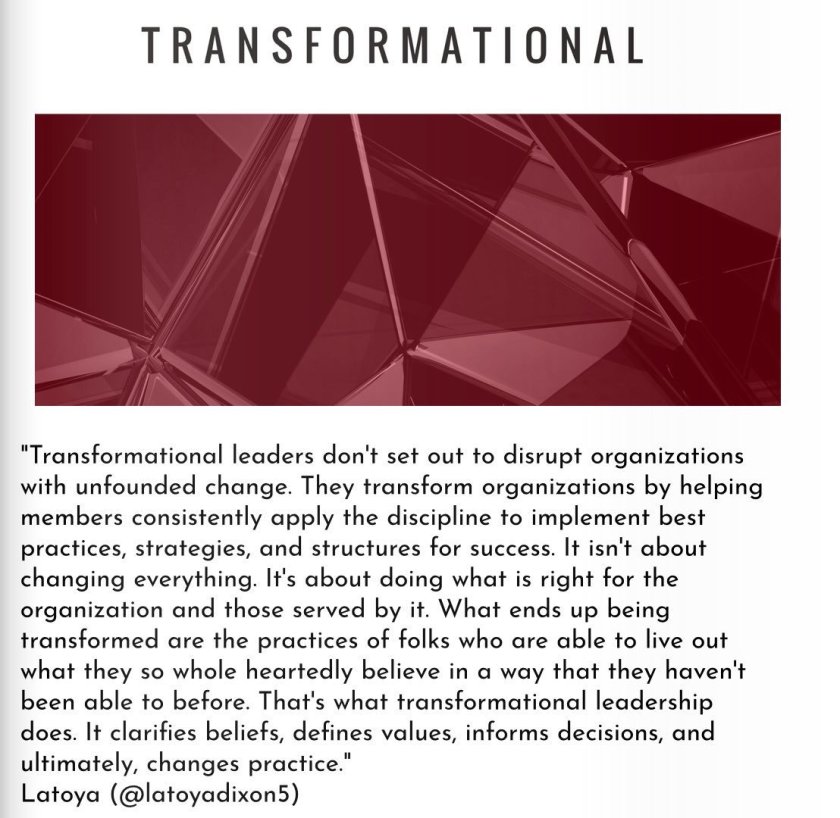
To Find Transformational Leaders, Transform The Way You Think About Leadership
# To Find Transformational Leaders, Transform The Way You Think About Leadership
Proven. Experienced. Hard-nosed. Decisive. Direct. Demanding. Fearless. Those are the words I’ve heard others use to describe their idea of a transformational leader. Often when an organization is broken, we are quick to look for people who are willing and have proven themselves to lead an organization to success. While that’s highly commendable, I beg to differ in that it’s not the only considerations that should be given when searching for a true transformational leader.
When we examine the practices of those we see as having the ability to successfully lead, it’s important to note the contributing factors that played a vital role in their success. Simply put, having been successful once, doesn’t make you a transformational leader. In fact, it’s not about having been successful multiple times or even experienced. There are, at least in my mind, some key considerations that should be taken into account when selecting a leader to transform a broken, perhaps disjointed, maybe dysfunctional organization whole and thriving again.
Consideration 1: Prior success does not guarantee future success.
It’s critically essential to identify the context and circumstances under which that person was successful as a leader and to determine if the troubled context and circumstances align with the leadership opportunity before them. In other words, consider the resources, tools, support structures, etc. that were present and/or contributed to the leader’s success. A simple example would be that being proficient at playing basketball doesn’t make you a star tennis player. The context is different. The objective of the game is different. The tools are different. The support needed to improve your game is different. The way you win is different. It’s the context of how your athleticism is used that makes you successful. Context matters. Don’t ignore it.
Consideration #2. It is not enough to be eager. It is not enough to be equipped. You must be both.
In considering folks for transformational leadership opportunities we are often in a place where we perceive the ideal candidate as one or the other. We tend to think, “This is so difficult that it will require a person who has a deep desire to be here”. We give credence to the need for a will to be present over the need for the skills, practices, and behaviors that are needed to truly transform what is said to be broken. On the other hand, it is not uncommon to hear folks express that because the organization is so broken the anticipated leader must be highly skilled. Their ability to do the job is ultra important. I contend that you must have both if you wish to be a transformational leader. You must be eager and you must also be equipped. One without the other is too one dimensional to really make a difference in what it is you are trying to change. The complexity of the situation or organization you are trying to transform also requires a complex skill set. We do no justice to the job of transformational leadership by boiling it down or characterizing it in a single-handed manner.

Consideration #3: In a situation of transformational leadership, some skills matter more than others.
It’s no secret that leadership involves the ability to use multiple skills given the context of a situation. While some situations may call for the leader to execute stellar emotional intelligence, other situations may require a more technical skill set. At any rate, transformational leaders are different in that they are able to recognize and prioritize the skill set most needed to bring success back to the organization. They don’t see themselves as having to be highly skilled in everything all the time. Instead, they are able to determine which skill they need to highlight to move the organization forward, and that changes given the context, circumstances, tools, and resources available. For example, a staff that has had a high degree of turnover at the leadership level requires a great deal of more emotional security than a staff who’s had relative stability in leadership. This means that the leader must be keen in the area of emotional intelligence at the onset of becoming the leader. He or she must pay close attention to the emotional needs of those members, and quickly capitalize on building trust. In this given context, building trust is more imperative than technical ability. Once trust is present, the leader can then focus on ensuring that he or she is modeling the technical ability needed to change outcomes, and influencing the improvement and talent of those who do the work on the ground level.
What seems to impair our ability to identify transformational leaders is that we tend to generalize leadership. Leadership isn’t general at all in my opinion. In fact, how you lead and why you lead, is extremely contextual. If we can give consideration to these elements mentioned here, we can improve our ability to identify and select transformational leaders who can truly change what is broken.
Until next time-be you, be true, be a hope builder!
Latoya
@latoyadixon5
Part 2-The Gap Between Knowing and Doing: Why Good Ideas Fail
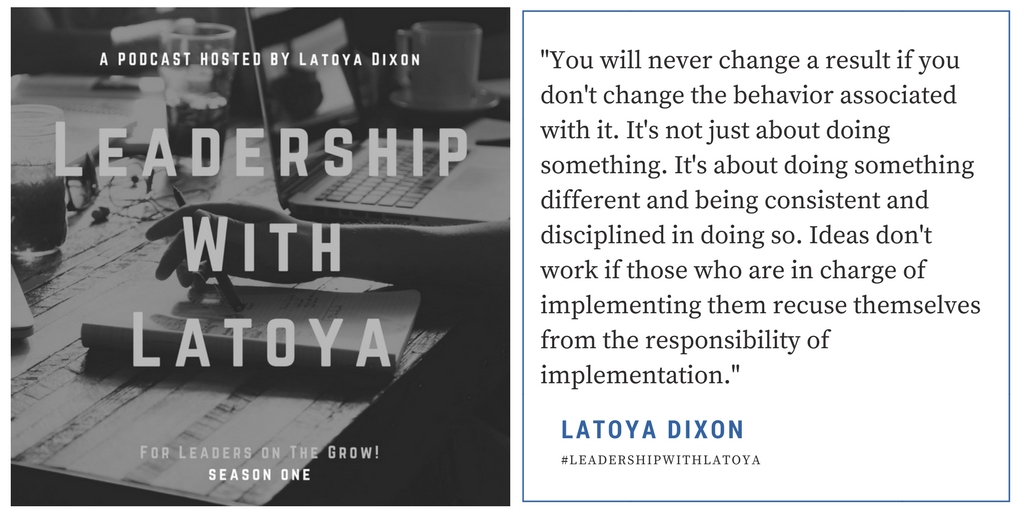
In an earlier blog post, I wrote about the difficulty of execution. I highlighted the idea that we often fail to do what we know because we lack discipline. Using eating healthy and dieting as an analogy, I oversimplified the difficulty in doing what we already know to be true. Although oversimplified, it certainly made the point clear. When things go awry, it’s not usually due to a lack of knowledge, but due to our inability to consistently execute the behavior and actions we know will lead to the results we desire. So often good ideas fail because of poor implementation. The idea gets criticized as a failure when in actuality the implementation of the idea was poor. In this blog post, I want to expand on this concept.
I’ve written on this blog multiple times about our “dessert smorgasbord” tendencies. That is, when we learn of what we perceive to be a good idea, we immediately want to try them out, along with all the other good ideas we’ve found enlightening. The problem is that we lack focus and clarity in our effort to solve problems because we try everything, instead of working to contextualize the solution and find the one thing we think will help, and then execute and implement it with discipline, consistency, and monitoring of implementation. When we lack such discipline in the implementation of what we’ve initially deemed to be a good idea, we have a tendency to rush to quick judgment and reject the idea citing that it doesn’t work. The truth is this: It’s not the idea that didn’t work. It’s you.
Now, that’s a bold statement. So let me further explain. Our human condition requires that we provide ourselves with a set structure, specific strategies, and the like in order to execute an action in a disciplined and consistent manner. In reflecting on my experiences as a leader and subordinate, so often when ideas have failed to achieve the results we had hoped they would produce, I’ve come to realize that it wasn’t the ideas at all. It was a lack of preparation for implementation, a lack of planning for providing the right support, education, and training around the idea, a lack of planning in the design for how the idea would be implemented, monitored, and the evidence that would be used to determine if it was in fact working. Why is this? What causes folks to struggle with the implementation and execution of consistent, disciplined behavior? What can be done to avoid the criticism of good ideas as failures when in fact it is a failure in implementation?
I’m no expert, but here are my thoughts. First and foremost, recognize that being a visionary is not enough. Having a vision, developing a shared vision, and communicating that vision is certainly important. However, there must be a distinct plan for reaching that vision. Dreaming is necessary for aspiration and accomplishing that which may seem impossible, but a dream without work is reduced to a wish. A vision without a plan for implementation-and I mean a well thought out, strategic plan, supported by a structure for the work to be done, is nothing more than a wish. Wishing doesn’t work, but working does. Good ideas often fail because those who are responsible for designing the implementation of them don’t plan well enough, aren’t strategic, don’t create or alter the structure of the work to support the implementation of the idea, and don’t develop a clear mechanism for supporting the education and training of those who are to actually go forward and implement it.
Secondly, we must acknowledge that people, in general, lack discipline. Most of us are creatures of habit, good or bad, and struggle to be disciplined in our work, our personal lives, our diets, and other things. Knowing this, it ought not be a surprise that when we decide to implement a good idea, that it requires an extreme amount of discipline and to help ourselves we must provide structure and strategy. This isn’t rocket science and I’m no scientist, but despite the fact that most folks know that every good idea is only as good as the ability to implement it with disciplined, strategic, action, folks still get stuck at visioning. Some might would disagree with me, but I believe that you can’t stop at the development of a vision. In order to make something happen, you have to do something, and that something has to be specific, strategic, and monitored regularly so that you don’t unconsciously slip into the mundane routine of “making it through the day”. I’ve watched so many folks declare a good idea a bad one because “it didn’t work” when in fact it wasn’t the idea at all. It was because he or she lacked the discipline to consistently execute the behavior needed to make the idea work, didn’t provide the right structure or strategy to support the implementation of the idea, and didn’t educate themselves or subordinates enough to implement the idea. The fidelity of implementation is a real challenge when it comes to making something work because the human condition lends itself to undisciplined behavior. It is our nature to operate in a state in which we do what is convenient, what is easy, what is best for us (instead of best for the organization), and what is comfortable. Failure to acknowledge the fact that good ideas require work and discipline, along with planning for implementation, will likely result in disappointment.
Thirdly, as leaders, I believe it is the leader’s responsibility to move the organization beyond vision. Some might disagree as I have heard over and over, the leader sets the vision. I don’t disagree with that, but in my opinion, it doesn’t stop there. If you recuse yourself as the leader from thinking about the details, your vision is reduced to a vague idea. Leaders should think about ideas not only in terms of their merit but in terms of their operation. What will this idea look like in practice? How will it work across various contexts and situations? What obstacles to implementing this idea can we anticipate? How can we work around or through the anticipated obstacles? What evidence will let us know if the idea is working? What support structures need to be put in place to aid in the implementation of the idea? Are there any specific strategies we should be focused on during the implementation? How often and who will monitor the fidelity of implementation? What does a successful implementation of this idea look like, sound like, feel like? Leaders who recuse themselves from thinking about or through these questions are predisposed to failure. That is, they are more likely to cite the idea as a failure because they lacked the discipline of planning for implementation and following through with the plan.
Good ideas are often cited as failures because the people charged with implementing the failed to do the work needed for the idea to be a success. The leadership gap is the gap between knowing and doing. Knowing alone is not enough to be a successful leader. Leaders who intend to be successful must bridge the gap by doing what it takes to get the work done and doing so with disciplined, consistent, and strategic action. That, my friends, is the leadership challenge so many face. You can start by acknowledging the lack of follow-through we humans are prone to and putting some support structures and strategic actions in place to counter that. I think that’s a good idea, and if you agree, do something about it.
Until next time-be you, be true, be a hope builder!
Latoya
@latoyadixon5
#leadershipwithlatoya
Who’s In Charge of Your Professional Development?
In our most recent episode of #leadershipwithlatoya, we tackle the topic of taking charge of your professional development. This is an all too important concept for leaders and others alike. If we wait to be invited to the next conference, for the next organizational offering, or for someone to mandate us to attend the company professional development, we sacrifice our own personal professional development and growth, limiting it to what is being offered to us instead of working to address gaps in our own skills. This is dangerous, yet an all too common tendency for leaders. It is so easy to get so immersed in the work we are responsible for that while we are pushing others, we forget to grow ourselves. If we aren’t careful, we wake up one day, and ask ourselves a question that we can’t seem to answer: What have I learned to help me be a better leader and a better learner?
I am constantly asking myself that very question. It is the core reason why I blog and podcast. I am a learner first, and a leader second. Without taking care of my own professional development and growth, the folks who I am responsible for working with as the leader, are subjected to my own limited knowledge, skills, and abilities. In order to build capacity in others, you must first build it in yourself. I’ve spent the last year learning a new job and I still have a great deal to learn. I am not perfect, and there have been many lessons learned this year. However, I am committed to learning and working to grow myself in those areas needed to be the best leader I can be for those I work with and serve. I am dedicated to making sure my contribution is adding value to our organization in a way that is clear, quantifiable, and positive.
My question for readers and podcast listeners regarding this topic are simple:
What are you doing to grow yourself professionally?
What excuses are standing in the way of you building your own capacity for leading?
How can you structure your time in a way to allow for you to develop yourself to maximize your potential?
How will you hold yourself accountable for you own professional development?
You are in charge of your professional development and growth. Don’t wait for the invite to the conference, the mandatory meeting, etc. If there’s something you want and need to learn, go do it!
Until next time-be you, be true, and be a hope builder!
Latoya
@latoyadixon5
#leadershipwithlatoya-Podcast Now Available on iTunes!